
The Unholy Trinity: Collective Trauma, Dissociation, and Moral Injury—and What Psychoanalysis Might Do About It
By Grant H. Brenner, MD, DFAPA
Two Cities, Then and Now
In China Miéville’s novel The City & the City (Miéville, 2010), citizens of two overlapping cities are trained in the art of “unseeing”—inhabiting the same physical space while systematically refusing to perceive what belongs to the other side. It is a radical dissociation elevated to dutiful civic co-existence. In 2017, writing in the wake of the presidential election, American life reminded me of this hyper-Orwellian polity—first in a Psychology Today piece, “The Shakedown of the American Psyche,” (Brenner, 2017) and then more formally in “Considering Collective Moral Injury following the 2016 Election” (Brenner, 2017). The breach was already visible then, and has deepened and spread, like cracks on a windshield. We see and unsee, bifurcating perceived futures into zoomer and doomer visions, missing a third, putative “tuner” option (Brenner, 2026).
Rifts have continued to widen and spread across scales—reflected in families, institutions, professions, globally. September 11th was a clawhammer blow to the global system early in the promising 21st century. Historical trauma identities à la Volkan (2001) have since become entrenched. Psychoanalysis itself has a long history of splitting and institutional infighting—Freud’s narcissism of small differences (Freud, 1930) persists as psychoanalysis cannot cure itself, the limits of self-analysis systemically. The question for those of us in the analytic community is live: How do politics come up in our individual consulting rooms, in our institutes, and on our listservs? Many listservs have torn themselves asunder.
This essay explores two interlocking frameworks. The first names the collective pathology: trauma, dissociation, and moral injury (TDM), an unholy trinity operating as a self-reinforcing system operating on many scales. The second offers an open-systems alternative drawn from psychoanalytic theory: the Tripartite Model of psychoanalysis, integrating Personalized Self-State Mapping (PSSM), Active Inference Therapy (AIT), and Experiential Field Theory (EFT) (Brenner, 2026). Regarding “trauma”, here I mean clinically significant trauma and/or psychoanalytically meaningful adversity, rather than the misleadingly common colloquial usages.
The Unholy Trinity—TDM
TDM articulates an interactive complex system which impedes clear thinking (in Bion’s sense, and others). Trauma centers on fear and survival, while moral injury centers on shame, self-condemnation, and transgression. They synergize and amplify one another, possibly reaching a tipping point resulting in motivation for change. Dissociation is a common response to overwhelming experience—posttraumatic, moral, or otherwise. Even positive overwhelming experience can trigger it (e.g. Lacanian jouissance). The three often co-occur, even if unseen.
Dissociation is also “normal”—tuning out noise, ignoring difficult issues, the absorbed flow state of creative work. The trouble begins when that becomes excessive: it locks in the systemic issues, interfering with and sometimes preventing the self-reflective function required for progress. Clinical research supports this—treating dissociation is required to treat co-morbidities (e.g. Macchia et al., 2025; Hill et al, 2025).
As a system, all three must be addressed. The amplification loop runs something like this: trauma provokes dissociation as defense; dissociation disables self-reflective function; with self-reflection offline, trauma and moral injury go unprocessed; unprocessed injury invites fresh trauma. Each element feeds the others. Does the world have DID, so to speak? If so, what’s the fix for this simply more human than otherwise bug?
Having a similarly complex model to frame how we might meet TDM is something to consider.
The Tripartite Model: An Open-System Alternative
Classical containment à la Bion presumes that difficult material can be held within a bounded, if evolving, space—the container metabolizes what the contained cannot yet manage and returns it in a digestible manner. But what if reality keeps giving us indigestion, and we have to move along regardless? How might one contain the uncontainable? One thought is rather than a bigger container, a different geometry altogether, a different paradigm. The “Tripartite Model”, discussed below, addresses these concerns.
Bion’s group-as-a-whole concept (Bion, 1961) points toward a collective awareness and force-multiplied action, pursuant to the main theme of our tour. We might imagine the tripartite model as a “countercontainer” or a “metacontainer”— a smart system which can dynamically open and close, in context- and developmentally-dependent ways.
Rather than a space holding objects within it, consider a metaphorical gravitational well keeping objects in relationship to it in motion (see Neural Geometrodynamics, Ruffini et al., 2024). The source of that gravity is attachment and relationship, by way of evolutionary adaptation. On average, we need each other more than we are bad for each other or need solitude. However, the only metaphor which truly fits is the thing itself, currently unknown and aspirational, possibly extant in a handful of futures.
EFT—Experiential Field Theory—creates the present-moment nexus within which TDM can co-exist without being resolved prematurely. Psychological reality, in this framework, is fundamentally experiential: how you look at it and what you make of it. Dissociated material surfaces as perturbations in the field—disturbances that can be noticed, attended to, or not, depending on what the moment requires. Following Bromberg, dissociation becomes interesting in the present moment: one can attend, or not, to whether a dissociative element overshadows the field.
A happy memory: In one of Philip Bromberg’s classes at William Alanson White, as a trainee I asked what was the affective experience of dissociation—my sense being that dissociation feels like something, however ephemeral. Bromberg’s attention was piqued. Gazing somewhere apparently a few inches to the right of my actual head, appearing pleasantly surprised, he said, “That’s an interesting question!” That’s all I got—like the time I was in Cochin, India, doing disaster psychiatry work, when a Brahmin priest with whom I’d spoken briefly said he’d meet me at the Hindu temple a few hours later to tell me important things, but he never showed up. These experiences share a common quality of juxtaposing absence and presence, anticipation and scarcity–exactly embodying some elusive truth about dissociation’s manifold nature, making the most of what is received while also wanting more.
Experience is somehow always here or arriving, off ahead of us, or indelibly gone, having left ripples in its wake. The discipline of the present moment attending itself is where change happens and agency lives. This is the only place change occurs, a deep and rich moment with limpid thickness, a nexus of experience with many geysers, drains, eddies and whorls, containing past, present and future, reality, imagination and possibility. Interpersonal psychoanalysis trains us in the use of this stationary-dynamic moment.
AIT—Active Inference Therapy, grounded in Karl Friston’s free energy principle (Friston, 2010; Brenner, 2025), provides the inferential engine. The core idea, translated for our purposes: organisms build models of the likely state of the world and continuously test and update those models through action and perception. Psychopathology, in this framing, shows up as rigid models—overly precise priors, in the technical language—that resist update despite contradictory evidence. The goal is to reduce surprise, to improve predication, through epistemic foraging. The Markov blanket, a term worth knowing, refers to the causal boundary of a system: in therapy, the envelope of the experience, within which all the relevant information for needed inference may be found. The Markov blanket functions as a smart causal boundary—separating inside from outside while mediating what passes between them.
AIT offers a way to make sense of how we explore the world and ourselves, and update our models—through perception-action loops. Bayesian inference is a factor: how we take in new information and use it to update our models, prior and posterior probabilities, stretching from linear past to future, folded within the present moment. Markov chains tell us the probability of moving to the next step versus going back to the last state; the blanket is an ensemble of such chains.
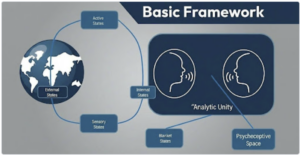
The unit of analysis in the Tripartite Model as far as therapy goes is the analytic unity (the term in self-organizing systems is “autopoieisis”, self-making). The analyst and analysand, comprising the analytic unity, engage in “interactive inference” within a psychoanalytic perception-action space I’ve called “psycheceptive” (Figure 1), which stands in relation to the world. When models do update, what was previously perceived as impossible becomes accessible—new worlds open. AIT gives the Tripartite Model its capacity for self-correction and both conscious and unconscious thinking.
Figure 1: World-Analytic Unity Interactive Inferential Relationship
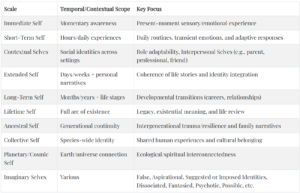
PSSM—Personalized Self-State Mapping—provides the structural roadmap for the sense of self in the present moment 1, including dynamic representation of past and future selves (and others, from an object relations perspective). The lineage here runs through Sullivan’s good-me/bad-me/not-me—a foundational recognition that selfhood is multiple, and that some of those multiplicities are dissociated, inaccessible to ordinary awareness—and through Bromberg’s Standing in the Spaces (1996), which argues that the goal is not necessarily integration of self-states but shared awareness: building communication among parts, co-consciousness rather than forced merger. This also evokes Bion’s linking and psychoanalytic theory of thinking (Bion, 1962)—a topology of fast, intermediate and slow processes which is interconnected in complex and evolving ways with both emergent and designed elements. PSSM works on a continuum, as some folks seem more singular, and others more multiplicitous, whether due to environment, temperament, or both.
Figure 2: The PSSM model identifies nine interconnected scales of self-continuity, and a tenth “wildcard” of imaginary selves, which in some ways may be the most important as it is a fulcrum for change.
One may arbitrarily draw a boundary and define all the components within that envelope as a system, and this will work. Yet not all choices have the same outcomes–some work better than others, and that is part of the model-updating demanded by active (or interactive, in the case of shared thinking) inference. And you may select as many units as you like, and you may consider how they interrelate. You have this freedom. As noted, participants can draw the causal envelope around themselves alone or recognize their membership in larger configurations—inside one unity but external to others. The boundaries themselves are intelligent; they process information, which is where AIT becomes critical.
TDM, when it takes hold, strips away agentic awareness of and influence over these boundary conditions. We stop sensing where we end and the chaos begins.
Cohabitation
All three components converge in the present moment as a shared experiential field—what might be called a shared manifold in which emerging therapeutic experiences become possible. The community of analysts experiencing TDM strain is itself a group operating within this framework, holding patients’ tensions collectively while also being subject to the same forces. AIT’s updating, PSSM’s multiplicity of perspectives, and EFT’s present-moment attending all operate simultaneously in any clinical encounter, and perhaps more importantly, in the life of the analytic institute itself. We might envision a “better world”—but are we imagining close enough future worlds to even be on the same landscape, or is it something else?
The analytic frame is, in the classical Freudian model, a brilliant and compact algorithm. Three components compressed into one instrument: the treatment frame itself (the agreement, scheduling, fees, goals), the Fundamental Rule (free association, with the patient noting self-censorship as it arises), and evenly suspended attention on the analyst’s part—as Freud noted it in his Recommendations paper (Freud, 1912). The interpersonal-relational tradition expands this, making more room for the analyst’s experience and explicit personhood and the patient’s capacity to listen and interpret. Freud’s basic model remains the core engine.
Traditionally, politics does not enter the consulting room except as the patient brings it, beyond the analyst’s involuntary self-disclosure; the analyst is there for the patient, not to press one’s own agenda or meet needs beyond reasonable income and healthy narcissistic professional satisfaction. In politicized times—and with analysts who tend liberal—this becomes contentious. Colleagues at times may advocate activism within the frame, offering psychoanalytic justifications for what is traditionally a frame violation. In a liberal institute, conservative views may become unsafe to voice—self-silencing, ironically given the acceptance and freedom of the analytic frame. This is a problem with MAGA and Israel-Palestine, and now Iran and a range of other lead-edges, and has always been a tension in psychoanalysis.
The dichotomy sharpens: analysts neutral in role, morally outraged by external events, often with sympathetic patients. Countertransference identification is an occupational hazard. Is there a role for overt politics in the consulting room? Under what conditions, if at all? How do we know we are not merely self-deluding? Can we only work with people who align with our views, or is there a higher calling—and is framing it that way itself moralistic? More questions than answers. Psychoanalysis faces real challenges as a balkanized field—whether we can share a coherent narrative and identity in the face of increasingly challenging global reality, now accelerated by AI.
When TDM is this overwhelming, external pressure threatens to force material through the analytic frame by psychic reverse osmosis, a frame arguably meant to protect and enable the analysis to flourish. An analyst frustrated with world politics, not tracking countertransference, feeling helpless—may enact, or act-in: expressing personal views, pushing agendas, undermining patients’ agency via overt or covert encouragement or dissuasion, challenging someone who supports a disliked political figure subtly or overtly, displacing their own issues onto the patient’s therapy and breaking the frame, perhaps betraying the patient’s trust.
Colleagues maintain they cannot work with patients holding views they find reprehensible—a valid position in its way, while the traditional ideal, also unfree from politics, holds that managing that countertransference is precisely the work. It is critically important during trying times for the analyst and the institution to be addressing this hazard, which can be born out of an effort to redress moral injuries, and an enactment of dissociated trauma and injury.
Negative Capability as Stance
This is not about resolution, sadly, and it is not even about action steps—that would be a whole other paper. The stance, here, is that we have choices if… starting with slowing down and paying attention. The work is to open the landscape, expand the sense of choice, and encourage agency—our own and our patients’ and our institutions’. We return to Miéville: the opposite of unseeing is choosing to see, even when what you see is uncontainable. Or better, seeing and unseeing–and going beyond seeing and unseeing, existing within “uncertainties, Mysteries, doubts, without any irritable reaching after fact and reason.” (Keats, 1899).
Being aware of how personal and group countertransference may limit versus liberate—and how it may be operating in ourselves as much as in our patients—could be among the more useful things we do right now. We are improvising when the score has been thrown out—holding ambiguity, tolerating uncertainty, not as passive endurance but as active psychoanalytically-informed stance. Whether TDM itself requires a unifying meta-framework, as the Tripartite Model provides for the therapeutic situation, remains an open question.
Perhaps the deeper issue is that the world lacks a developmental object—an object in relationship to which genuine growth becomes possible—and that without one, surviving the next few decades may prove more difficult than we imagine. AI is an existential threat, but it could also hold promise to enable or assist humanity in creating such a developmental object, or even be part of such a developmental object (to the consternation of many), something we may need, if not desire. What role, if any, psychoanalysis could play in the face of the collective systemic challenges we face—psychologically and materially—remains to be determined, and may be a matter of fleeting choice.
1. An informally-applied mathematical structure which could underlie something like PSSM—bistochastic polytopes and Markov blankets—is discussed in “How AI Illuminates the Architecture of Personal Transformation,” Brenner, Psychology Today, 2026.
Grant Hilary Brenner, MD, DFAPA, is a board-certified psychiatrist, psychoanalyst, organizational consultant, author, influencer, and educator known for integrating neuroscience, psychodynamic therapy, and compassionate innovation in clinical care. Based in Manhattan, he is Founder and Director of Brighter NeuroTherapeutics. He serves on the voluntary faculty of the Icahn School of Medicine at Mount Sinai Beth Israel and the Manhattan Institute for Psychoanalysis. His teaching and clinical supervision reflect a broad commitment to bridging scientific inquiry and humanistic understanding.
Dr. Brenner is a Distinguished Fellow of the American Psychiatric Association and a Fellow of the New York Academy of Medicine. He received the 2025 Bruno Lima Award for Excellence in Disaster Psychiatry from the American Psychiatric Association, as well as the 2025 Castle Connolly Top Doctor Award.
His leadership includes board appointments with Vibrant Emotional Health and Languages of Care, and Co-Chair roles for the Disasters and Global Health Committee of the Group for the Advancement of Psychiatry. He is a co-founder of the Mental Health Media Group and New York Comprehensive Wellness Management.
He is the co-author of Irrelationship, Relationship Sanity, and Making Your Crazy Work for You (Central Recovery Press) and editor of Creating Spiritual and Psychological Resilience: Integrating Care in Disaster Relief Work. His ExperiMentations blog for Psychology Today explores the intersection of psychology, neuroscience, ethics, and human transformation. The Doorknob Comments Podcast examines modern life, love, personal growth and development, and a range of topics of interest. He is former co-founder and CEO of Neighborhood Psychiatry and Wellness, having exited the company after acquisition.
References
Bion, W. R. (1961). Experiences in groups, and other papers. Tavistock Publications.
Bion, W. R. (1962). A theory of thinking. The International Journal of Psychoanalysis, 43, 306–310.
Brenner, G. H. (2017, February 24). The shakedown of the American psyche. Psychology Today. https://www.psychologytoday.com/us/blog/experimentations/201702/the-shakedown-the-american-psyche
Brenner, G. H. (2017). Considering Collective Moral Injury following the 2016 Election. Contemporary Psychoanalysis, 53(4), 547–560. https://doi.org/10.1080/00107530.2017.1384683
Brenner, G. H. (2025). Active inference therapy: A first-principles framework for psychotherapeutic intervention. Neuromodec Journal. https://neuromodec.org/2025/11/active-inference-therapy-a-first-principles-framework-for-psychotherapeutic-intervention/
Brenner, G. H. (2026, January 3). How AI illuminates the architecture of personal transformation. Psychology Today. https://www.psychologytoday.com/us/blog/experimentations/202601/how-ai-illuminates-the-architecture-of-personal-transformation
Brenner, G. H. (2026). A tripartite psychotherapy model integrating personalized self-state mapping, active inference therapy, and experiential field theory with neuromodulation: Foundations and future directions for precision interventional psychiatry. Neuromodec Journal. https://neuromodec.org/2026/01/tripartite-psychotherapy-model/
Brenner, G. H. (2026, March 1). Are you a doomer, a zoomer… or a tuner? Beyond fight-or-flight post-Citrini: What the AI crisis revealed about how we think — and the grounded responses it actually requires. ExperiMentations. https://granthbrenner.substack.com/p/are-you-a-doomer-a-zoomer-or-a-tuner?r=1a9yis
Bromberg, P. M. (1996). Standing in the spaces: The multiplicity of self and the psychoanalytic relationship. Contemporary Psychoanalysis, 32(4), 509–535. https://doi.org/10.1080/01062301.1996.10573183
Freud, S. (1958). Recommendations to physicians practising psycho-analysis. In J. Strachey (Ed. & Trans.), The standard edition of the complete psychological works of Sigmund Freud (Vol. 12, pp. 109–120). Hogarth Press. (Original work published 1912).
Freud, S. (1961). Civilization and its discontents (J. Strachey, Ed. & Trans.). W. W. Norton & Company. (Original work published 1930).
Friston, K. (2010). The free-energy principle: A unified brain theory? Nature Reviews Neuroscience, 11(2), 127–138. https://doi.org/10.1038/nrn2787
Hill, S., Kate, M.-A., Hegarty, D. L., & Buchanan, B. (2025). Exploring the complex relationship between anxiety and dissociation in a clinical population. Australian Psychologist, 60(6), 509–525. https://doi.org/10.1080/00050067.2025.2567676
Keats, John (1899). The Complete Poetical Works and Letters of John Keats, Cambridge Edition. Houghton, Mifflin and Company. p. 277.
Macchia, A., Mikusky, D., Sachser, C., Mueller-Stierlin, A. S., Nickel, S., Sanhüter, N., & Abler, B. (2025). Trait dissociation in borderline personality disorder: Influence on immediate therapy outcomes, follow-up assessments, and self-harm patterns. European Journal of Psychotraumatology, 16(1), 2461965. https://doi.org/10.1080/20008066.2025.2461965
Miéville, C. (2010). The city and the city. Random House Worlds.
Ruffini, G., Lopez-Sola, E., Vohryzek, J., & Sanchez-Todo, R. (2024). Neural Geometrodynamics, Complexity, and Plasticity: A Psychedelics Perspective. Entropy, 26(1), 90. https://doi.org/10.3390/e26010090
Volkan, V. D. (2001). Transgenerational transmissions and chosen traumas: An aspect of large-group identity. Group Analysis, 34(1), 79–97







Leave a Reply
Your email is safe with us.